For clinics, groups and organisations

Your own instance. Your servers, your data, your source code.

A full ERP, CRM and EHR in one database, on your server or a dedicated one we rent to you — plus custom development that turns your own way of working into part of the product. Built on Odoo, open source; buy the ownership licence and the modules and their source are yours.

What you are actually buying

An EHR is one of ten areas. The ERP and the CRM are the other nine — and then there is the part that is not a product at all

A record system keeps the clinical record. It does not run the rota, pay the practitioners, chase the referrer, raise the invoice, or report on any of it. So a clinic buys a record system, then buys four more things, then pays somebody to keep the five in agreement. This is one system, on one database, and it arrives as all three.

ERP

The business that runs the care

Odoo Community underneath: open source, with no Odoo licence fee and nobody locked in.

  • Rota, rooms and resources
  • Orders, invoicing, payments and accounting
  • Practitioner pay on four formulas, with contract version timelines
  • Payout runs that write real supplier bills
  • HR, time off, expenses, procurement and inventory
  • Governance, training and workforce designations

CRM

Everything before somebody is a patient

The half of the funnel a record system has no model for.

  • Referrer and partner register
  • Enquiry capture with a clock on it
  • Website, content, campaigns and newsletters
  • Events, courses and certificates
  • Attribution from first click to admitted patient
  • Booking funnel analytics — views, starts, drop-offs

EHR

The clinical record, in full

Encrypted per document and per field, with the keys held separately.

  • Episodes from admission to discharge
  • Versioned treatment plans with nested goals
  • Template-driven notes with typed answers
  • Scored instruments charted over the episode
  • E-signature bound to the record it belongs to
  • Seven compliance packs, installed per market

+

Custom development — the thing on your paper, built into the product and owned by you

Every clinic has a way of working that no product has a page for. A triage rule nobody else uses. A report the board asks for in a shape no vendor ships. A funding stream with its own arithmetic. On a fixed product, that is a feature request. Here it is a module.

You get the source. The module sits in your repository, on your server, under your upgrade schedule. If we stopped trading tomorrow, it would still run.

  1. You describe it the way you actually do it — on paper, in a meeting, in the spreadsheet you have been using instead.
  2. We build it as a module on the platform, against the same models the rest of the product uses. It is not a bolt-on beside your data; it is part of it.
  3. It ships with your instance, and it is in the inventory with everything else — tested, versioned, and visible under Apps like any other module.
  4. You own it. Keep it private, or hand it to the next supplier. Neither needs our permission.
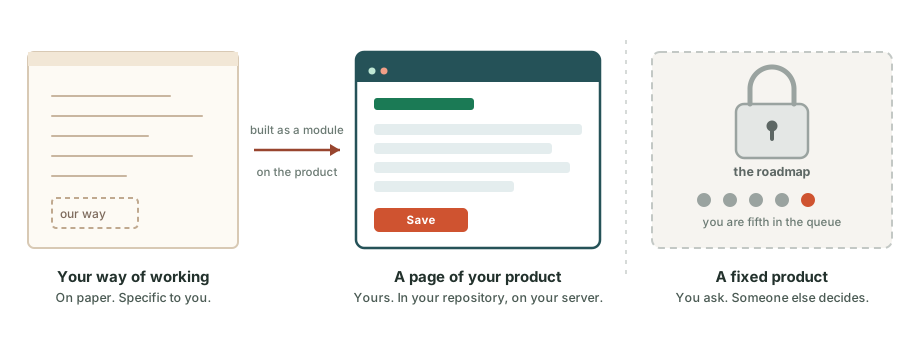
Left: a hand-drawn sheet describing a clinic's own way of working, with a box labelled our way. An arrow across the middle reads built as a module on the product itself, leading to a running page of the product with a Save button, labelled yours, in your repository, on your server. Set apart on the right behind a dashed line: a fixed product drawn as a padlocked box labelled the roadmap, with five dots beneath it and the caption you are fifth in the queue.
The difference is not how fast somebody builds it. It is who decides whether it gets built, and who owns it afterwards.

How unusual that is, stated carefully. Our own feature comparison puts this platform against seventeen others — ten in the United States, seven in Europe. On the row custom development on the product, owned by the clinic, exactly one of those seventeen also has it: OpenEMR, which is self-hosted open source. The same is true of full source access. For the other sixteen, the product is the product: you file a request and you wait your turn behind everyone else who filed one.

That is the whole claim, and it is the shape of the claim we are willing to make. We are not telling you our competitors are bad software — several are very good at the part they do. We are telling you what happens the first time you need something they have not decided to build.

Source: docs/marketing/08-COMBINED-FEATURE-MATRIX.md §6, rows O5 and O10, across the eighteen-platform table. Marks are read conservatively: a partial or higher-tier-only implementation counts in a competitor's favour.

Why an organisation does this

Four arguments, each one a mechanism and its consequence

The mechanism is what the system actually does. The consequence is the part you can check against your own week. No claimed percentage improvement appears on this page — we have none that are sourced, and §Work out your own case gives you the arithmetic instead.

Efficiency — the work that stops existing

Most clinics run four systems: a booking tool, a clinical record, an accounting package and a marketing list. The cost is not the four subscriptions. It is the people who carry data between them, and the disagreements when they miss something.

  • One database carries the clinical record, the schedule and the invoice — the invoice and the booking are the same data, so nobody reconciles them
  • Reports are built from the data you already enter — the reporting round stops being an assembly job from four exports
  • Payout runs produce real supplier bills in the accounts — no spreadsheet handed to the bank, and no re-keying of it
  • Roles are configuration — adding reception, supervision, quality or a case worker is a permission, not a project
  • A new brand or a second site is a configuration choice, not a new project

Revenue — money that is already yours

None of this is new business. It is revenue your current process loses on the way through.

  • Cancellation policy with tiered penalties, applied automatically — late cancellations and no-shows currently written off because nobody chased them
  • “Not yet booked” — sessions bought but unscheduled, shown as a list. The single most overlooked number in a clinic
  • Recalls — repeat episodes that currently depend on somebody remembering
  • Enquiry capture with a clock on it — enquiries that die in a shared inbox over a weekend
  • Attribution from first click to admitted patient — which channel produces patients, not clicks, so spend moves to what works
  • Four figures that always agree — sessions bought, going to earn, earned, not yet booked

Performance — knowing, fairly

The platform answers a question most reporting products do not: is the record true? — not only how are we doing?

  • Alignment reports — where the record and what happened disagree. An empty report is the good outcome
  • Six fairness rules enforced by the system — rates hidden below a minimum sample; what a person controls separated from what they do not; every figure one click from the sessions behind it; no league table on a person’s own page
  • Outcome measurement at admission and discharge — evidence that treatment works, in a form you can put in front of a payer, a regulator or a board
  • Occupancy and capacity — whether the constraint is rooms, hours or demand, which is a different decision each time
  • A professional sees only themselves — enforced by permission, never by a pre-set filter

Satisfaction — what the patient notices

  • Booking against real availability — they book, and it is booked. No call-back, no telephone tag
  • Their own portal — their documents, their plan, their goals, their progress
  • Monitoring between sessions — care continues instead of pausing for three weeks
  • Secure messaging with their clinician — a question answered without an appointment
  • One record — they are not asked the same question by three different people
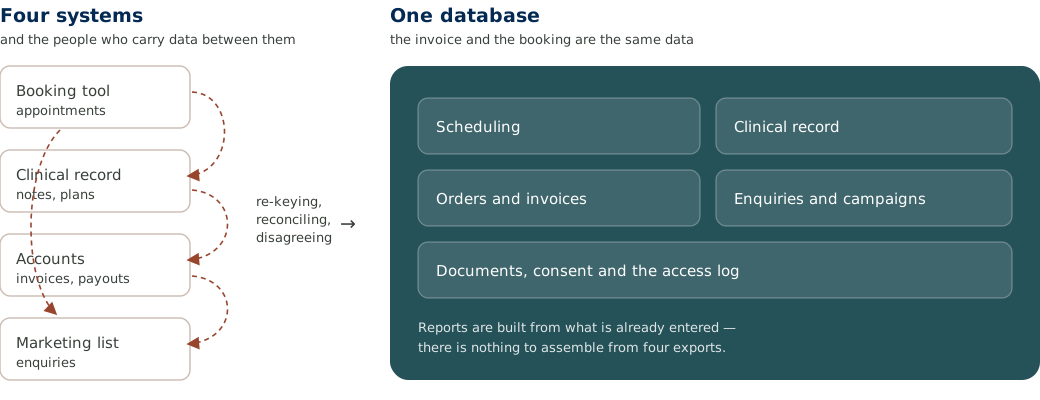
On the left, four separate systems — a booking tool, a clinical record, accounts and a marketing list — with dashed arrows between them labelled re-keying, reconciling and disagreeing. On the right, one database holding scheduling, the clinical record, orders and invoices, enquiries and campaigns, and documents with the access log.
The cost is not the four subscriptions. It is the people who carry data between them, and the disagreements that appear when they miss something. On one database the invoice and the booking are the same data, so there is nothing to reconcile and nothing to assemble a report from.

Not only self-hosted

A company can use our hosted service too

Your own instance is one way to have it. The other is the hosted service the practitioners use: your organisation on the marketplace, your experts under it, and your own domain if you want one. Nothing to run.

Clinic

plan 4
A team0% if listed

For a practice with several practitioners, rooms to manage and somebody who answers for all of it.

£99per month
£990per year

Up to 5 practitioners, then £19 eachUp to 5 practitioners, then £190 each a year

Start 30 days free
  • Everything in Practice
  • Rooms, resources and group sessions
  • Roles, permissions and an audit trail
  • Practitioner payouts and statements
  • Clinic reports and CRM
  • Unlimited reception and admin users
0% if you are listed. Otherwise 0.5% of sessions, at most £20 per practitioner Same rule across the clinic. Payouts are worked out from what was actually collected, and the card provider’s fee is added at cost.

Company

The marketplace

Your company and its experts listed on the companies marketplace. We take 25% of a client’s sessions 1–10, 20% of sessions 11–15 and 15% from session 16. This plan does not allow inviting your own clients, and there are no optional extras.

Freeper month
Freeper year
List my company ↗

What a company pays, in full

  • £99 for up to 5 practitioners, then £19 each. £990 a year for the first five if you pay yearly (2 months free).
  • Commission on your own clients: 0% while your practitioners are listed on the marketplace; otherwise 0.5%, at most £20 per practitioner a month.
  • Clients the marketplace finds: 20% down to 10% as they stay, with a plan.
  • On payments through us, the card provider’s fee at cost. Your own payment link adds nothing.
  • Your own domain for the company: £79 a month. AI Clinic Insights is planned at £39 a month per Clinic account and is not available yet.

See the plans and apply ↗ Your own domain

1

Your company page

on the companies marketplace

Company information, and the experts who work under it, shown together. Clients see what they already have with you.

Browse the companies ↗

2

Your own domain

on the hosted service

Your company on your own address, with your name, your menu and your experts and nobody else’s.

How your own domain works

3

Plans, and apply

hosted, nothing to run

The plans and prices for the hosted service. Choose one and apply from there.

See the plans and apply ↗

The price list

Four tiers, one-time, and nothing behind “contact us”

Licence plus implementation, paid once. Then support at 18% a year of that total. Run it on your own server, or rent a dedicated one from us with backups, monitoring and maintenance on us.

Tier, for about 25 usersOne-timeSupport a yearServer rent a monthOwnership licence
StarterBooking, your website, CRM and the client portal£13,395£2,411about £201 a month£175£9,376
GrowthStarter, plus finance, HR, marketing and projects£50,820£9,148about £762 a month£325£35,574
EnterpriseGrowth, plus a branded mobile app, e-signature for HR and events£104,190£18,754about £1,563 a month£650£72,933
Clinical EnterpriseEnterprise, plus ten clinical modules: care plans, notes, monitoring, records and retention, governance, health checks, e-signature for health, secure documents and portal, intake£174,190£31,354about £2,613 a month£950£121,933

Pounds excluding VAT. Indicative list prices for a company of about 25 users, confirmed by a written quote; other sizes are re-quoted. There is no commission per session on a self-hosted instance. To choose the modules yourself, use the calculator. The ownership licence column is 70% of the one-time total, bought with the project or later.

AI

Private AI

on your own server — in development

The session assistant running on your hardware, with consent and logging built in. About £18,000 one-time with set-up, and £3,240 a year for support and model updates.

StatusDesigned, not available yet. Nothing about it is in production.
TB

Tailored builds

a module or a system to your brief

Projects average about £154,000 and are quoted one by one, with support at the same yearly rate.

What you getTested, versioned modules that ship with your instance and belong to you.
H

Hospital systems

clinical modules and an ERP for a hospital

Quoted individually. Projects start from about $0.8M and run to several million, delivered over about fifteen months.

StatusNo hospital system is live yet; the modules are built per project.

On the live platform

Tailor it, then look around

The calculator prices a self-hosted instance; the marketplaces show the hosted service in use.

CA

Tailor your instance

the self-hosted calculator

Switch on the modules you want and the calculator gives a one-off build figure and a yearly support figure, itemised.

Open the calculator ↗

EX

Experts marketplace

browse and book

Every listed practitioner, their services and their reviews, on the live marketplace.

Browse the experts ↗

CO

Companies marketplace

organisations and their experts

A company's profile, and the experts who work under it.

Browse the companies ↗

Ownership

Own the modules, not just use them

The ownership licence is one number: 70% of the project value, for every tier and for hospitals. It is a perpetual licence to our modules for your own use, with the source and the right to modify; resale, sublicensing and transfer need our written consent, and counsel drafts the final clause.

  • The source code, in your hands
  • Your own developers can change it — we train four of them in five days for £8,500
  • A major upgrade every three years at 25% of the original project value; yearly support covers the patches
  • Buy support from us, or from any Odoo team you trust

What the licence costs, by tier

70% of the one-time total.

  • 01Starter — £9,376
  • 02Growth — £35,574
  • 03Enterprise — £72,933
  • 04Clinical Enterprise — £121,933

What is in the instance

Ten areas. Every one of them ships, and is tested.

This is not a roadmap. The module-by-module inventory is generated from the code itself, so the figures below are counted rather than claimed.

94modules
513models
271test files
7compliance packs
0Odoo licence fees
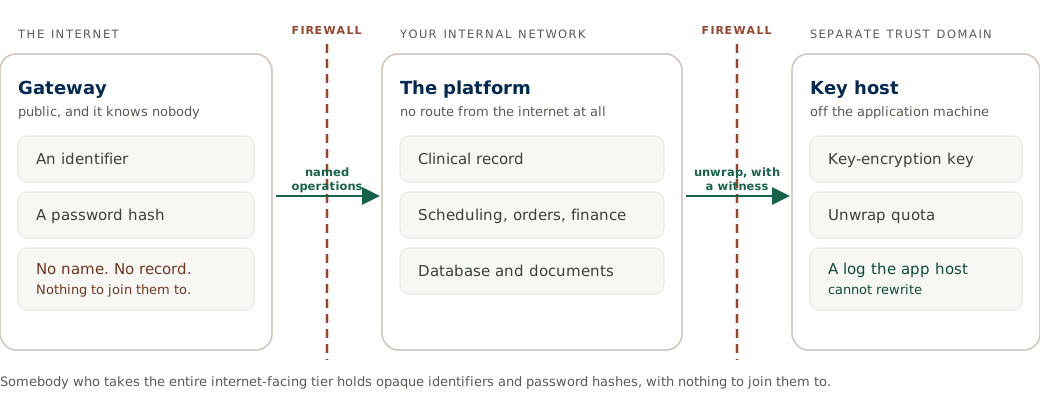
Three zones separated by two firewalls. On the internet, a gateway holding an identifier, a password hash and nothing that names anybody. Behind the first firewall, your internal network with the clinical record, scheduling, orders, finance, the database and documents, reachable only through named operations. Behind the second, a key host in a separate trust domain holding the key-encryption key, an unwrap quota and a log the application host cannot rewrite.
The isolated option, offered where the duty is heavier. It is not the standard deployment and it costs more to run — three hosts, two firewall rules and a key authority instead of one server. Ask for it when a regulator, an insurer or your own security policy makes the ordinary arrangement hard to defend.

Who uses it

Eight kinds of person, and a ninth you define

A role is configuration. Supervision, a county case worker, an external partner — each is added and permitted, not built.

ClinicianTheir caseload, diary, notes, plans, instruments, goals, reports, messages
Clinical administratorEverything clinical across the service, plus client transfer and oversight
ReceptionDiary, booking, arrivals, payments — and not the clinical record
FinanceOrders, invoices, payouts, dashboards — and not the clinical record
ManagerAlignment and performance reports, occupancy, capacity
QualityOutcome measurement, the governance register, the health check
ClientTheir own portal, and nothing else
Anything elseA role is configuration, not a project
Access is enforced at three independent levels, and a user must pass all three

Role, module access, and a record rule enforced in the data layer rather than on the screen — so the rule holds through an export and through a report, which is where most products leak.

Getting ahead

Four moves your competitors cannot easily make

Not because they are worse at running a clinic. Because their licence, their vendor or their data model will not let them.

01

Open the system wide

without a budget conversation

Give reception, supervision, quality, a referrer or a county case worker their own access. The licence is priced for the organisation, not counted seat by seat, so the question is whether they should have it — not what each login costs.

What stops a competitor Paying per seat means rationing access. Rationed access is why their data is incomplete, and incomplete data is why their reports are arguments.
02

Prove outcomes

to a payer, in their language

Scored instruments at admission, during treatment and at discharge, charted, tied to the episode and the plan that produced them. When a commissioner, an insurer or a board asks what your treatment achieves, you answer from the record.

What stops a competitor A clinic whose outcome questionnaires live in a separate tool answers with an estimate, and an estimate loses a tender to a number.
03

Launch a second brand

as configuration, not a project

A new service line, a new site or a whole second brand is a configuration choice. Same database, same reporting, separate public face — and one set of numbers at the end of the month.

What stops a competitor On a per-tenant product they buy a second subscription, and then reconcile two sets of numbers for the rest of the brand’s life.
04

Change vendor

including changing us

The foundation is open source and the database is yours. You can take it, host it elsewhere, or have somebody else maintain it — and we know that when we quote you.

What stops a competitor Nothing, except that their supplier cannot offer it. It is the strongest position a buyer of clinical software can hold.
What we will not claim

That software makes you compliant. That anything is unhackable. That our staff could never read your documents under any circumstance. Those are all false, and a supplier who says them to you is telling you something about their other claims.

The arithmetic

Private is for control. It is not the cheap option, and we say so

25

Hosted Clinic, 25 practitioners

nothing to run

  • £479 a month
  • £5,748 a year
  • About £17,244 over three years
25

Private Starter, about 25 users

your instance, on a server we rent you

  • £13,395 once
  • £2,411 a year support and £175 a month rent
  • About £26,928 over three years
?

So why choose Private?

three reasons, none of them price

Your data must sit in a place you control; you want to own and change the software; or you need modules that do not exist yet. If you only want to run a clinic, the hosted plan is the cheaper way.

Customisation

Built to how you work, at a rate you can hold us to

Change requests, migrations and set-up are priced by the hour. A developer writes code; configuration sets the software up without writing any. You choose the region the hours are worked in.

Per hourAsiaWestern EuropeEurope & UKUSA
Developerwrites the code — technical configuration, suggested customisation and data migration£50 an hour£65 an hour£80 an hour£120 an hour
Configurationsets the software up without writing code — configuration hours only£35 an hour£45 an hour£60 an hour£70 an hour

Pounds excluding VAT. Every job is estimated in hours before it starts, and the code written for you is yours.

Two ways to have it

Run it yourself, or let us run it

Both are your own instance and your own database. The difference is who holds the servers — and you can move between them later, because that is a database and a file store moving, not a rebuild.

Self-hostedHosted by us
Where it runsYour datacentre or your cloud accountOur infrastructure
Who holds the dataYouWe do, as your processor, under contract
Who patches the serversYou, or us under a management agreementUs
Upgrade timingEntirely yoursAgreed window
Isolated-network optionYes — the full isolated architecturePartly; the internal zone is ours, not your LAN
SuitsAn IT function, a security policy that requires it, or a legal duty that makes it simplerWanting the capability without running servers
Cost shapeLower recurring; you carry the infrastructureHigher recurring; nothing to run

Where your data sits

One database, and an isolated option where the duty is heavier

The standard deployment is a straightforward one: application, database and file store behind TLS, with roles and record rules doing the access work.

Where the duty is heavier we offer an architecture in which the clinical record has no route from the internet at all. An internet-facing gateway serves patients and referrers and holds an identifier and a password and nothing else; it reaches the internal system only through a fixed list of named operations from one address; the encryption keys sit on a third host in a separate trust domain.

What that buys, precisely: somebody who takes the entire internet-facing tier holds a set of opaque identifiers and password hashes with nothing to join them to.

Security, and one honest limit

The full security and compliance reference ↗

  • Encryption per document and per field — you choose what
  • Key custody off the application host, with an unwrap quota and a log that host cannot rewrite
  • Access log on every read and write. Being an administrator grants nothing by itself
  • Break-glass — time-boxed, needs a written reason, raises an alert
  • Automatic logoff after inactivity, enforced on the server
  • Disposal by destroying the key
  • HIPAA, GDPR and UK packs — the obligation is yours; what we carry is your copy of it

The honest limit: no key-custody design defends against an attacker resident in the application process waiting for legitimate reads. A legitimate open unwraps a key into the process. What the design buys is rate-limited access with a witness — not prevention.

Getting live

Eight phases, and the two things that decide how long

DiscoveryYour structure, roles, pathways, reporting obligations and current systems
FoundationInfrastructure, platform, roles and record rules, your branding, your language
Clinical configurationEpisodes, note templates, instruments, treatment plan structure. Your model, not a default
OperationsScheduling, capacity, finance, purchasing, payroll interface
AcquisitionWebsite, enquiry capture, referrer register, campaigns
MigrationFrom your current systems, scoped once we have seen them
TrainingRole-based, in your language
HypercareA raised response level after go-live

Duration depends on two things only: how much configuration your clinical model needs, and how much data has to move. A straightforward deployment runs in weeks; one replacing an established clinical record system runs longer, and we will not quote it before seeing that system.

Tell us what you run today

We will quote the tier, the server and the ownership licence in writing.