
For therapists and counsellors
Run your practice. And be found by the people looking for you.
Diary, payments, notes, plans and outcomes in one place — and a listing in our marketplace that works while you are in session. Two weeks free, no card.
Why this is worth it
Four arguments, before the feature list
Each one names the mechanism — what the software does — and the consequence, which is the part you can check against your own month. There are no percentage claims on this page. We have none that are sourced, and a number invented for a brochure is one you would quote back at us.
It gives you your evenings back
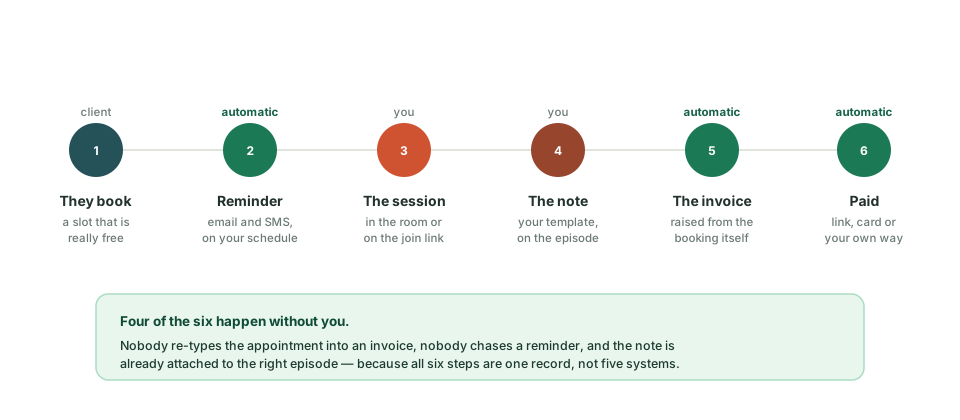
- Your diary, notes, documents and money are one system — no copying an appointment into a notes app and a spreadsheet
- Clients book against your real availability — no telephone tag, no “let me check and come back to you”
- Notes are templates with typed answers, not a blank page
- Session reports, invoices and payout figures come from work you already recorded — month end is a page you open, not a job you do
- Reminders go out on their own. You are not the reminder service
It reaches money you are losing now
None of this is new business. It is work you already did, or nearly did.
- Cancellation policy with tiered penalties, applied automatically — the late cancellations you write off because chasing feels awkward. The system applies the policy, so you are not the one asking
- “Not yet booked” — sessions bought and never scheduled. Most practitioners are surprised by this number
- Recalls on a date you set — clients who would come back if asked, and are not asked
- Packages and memberships — paid in advance, and a reason to return
- Your short link — clients you bring are charged at your own-client rate, not the platform rate
It lets you show that your work works
- Scored instruments at intake, during and at discharge, charted — in a form a payer, a referrer or a supervisor accepts
- Versioned treatment plans with a review history — that the plan was reviewed, when, and by whom
- Your own analytics — which services sell, where bookings come from, what converts
- Public answered questions and moderated reviews — reputation that accumulates and is findable
It makes you easier to be a client of
- Book instantly, against real availability — the commonest reason somebody gives up on finding a therapist is the wait for a reply
- Their own portal: documents, plan, goals, progress
- Monitoring between sessions — care continues in the three weeks between appointments
- Secure chat — a question answered without booking an appointment
- One record. They do not repeat themselves
What you get
The whole practice, in one workspace
Nine areas, and what is actually inside each one. The chips at the foot of every card say which plans carry it — Diary, Practice, Clinic — so you can read this once instead of twice.
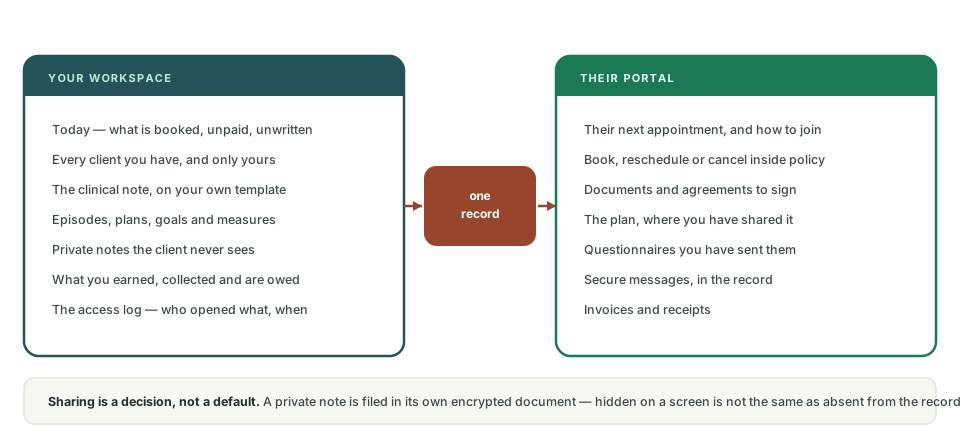
Your workspace
One screen that opens on today rather than on a menu.
- What is booked, and who has not confirmed
- Sessions delivered with no note written
- Invoices raised and not yet paid
- Messages and consultation requests waiting on you
- A daily digest, if you would rather be told than look
Clients
A record per person, and nothing about anybody else’s clients.
- Contact details, emergency contact and GP where you record one
- Consent captured once, dated, and withdrawable
- Every session you have had with them, in order
- Their documents, their invoices and their messages in one place
- A returning client keeps their history rather than starting again
Availability and scheduling
Clients book what is genuinely free, not what a form hopes is free.
- Working hours, with exceptions and holidays
- Lead time, buffers either side, and booking granularity per service
- Rooms and resources, so two people cannot take the same one
- Time zones handled, for a client who moves or travels
- Your own booking page, on a link you can put anywhere
Sessions
In the room or online, with the policy applied rather than negotiated.
- A join link for video, issued per session
- Reschedules inside the window you set
- A tiered cancellation policy that charges the fee automatically
- Packages and session credits, drawn down as they are used
- Group sessions, filed per attendee rather than once
Clinical work
The part a diary cannot hold, kept the way a regulator expects.
- Episodes of care, from first contact to discharge
- Treatment plans with nested goals and objectives, kept in versions
- Notes on your own templates, with typed answers rather than free text alone
- Scored questionnaires charted over the episode, kept with the version that produced them
- Between-session monitoring the client fills in from their phone
- Intake forms, filed encrypted against the episode — all four, in detail below
Documents, consent and signature
Encrypted per document and per field, with the keys held separately.
- Agreements sent, signed and bound to the record they belong to
- The signed copy kept where you can produce it years later
- Retention set per document type, not per folder
- Disposal by destroying the key rather than deleting a row
- An access log no administrator can edit — including ours
Talking to clients
Inside the record, so a conversation is not lost in a personal inbox.
- Secure messaging attached to the client, not to your email
- Consultation requests before either of you commits to a course
- Metered chat consultation, where you charge for it
- A client portal that is theirs to read, on web and on the app
- Push, email and SMS notification, on the channels you allow
Money
Raised from the booking, so the two can never disagree.
- Payment links, cards, or collect it your own way
- Packages and credits, with what is left always visible
- Invoices and receipts the client can fetch themselves
- A statement: earned, collected, outstanding, and our share named
- Your own business name, address and VAT number as the seller
Profile, reputation and reports
What the marketplace shows, and the numbers underneath it.
- A public profile that ranks on what you have filled in
- Answered questions that accumulate and keep working
- Moderated reviews, with a right of reply
- Where your bookings came from, click by click
- Utilisation, no-shows and outcome trends, for your own eyes
The part that makes it a clinical system
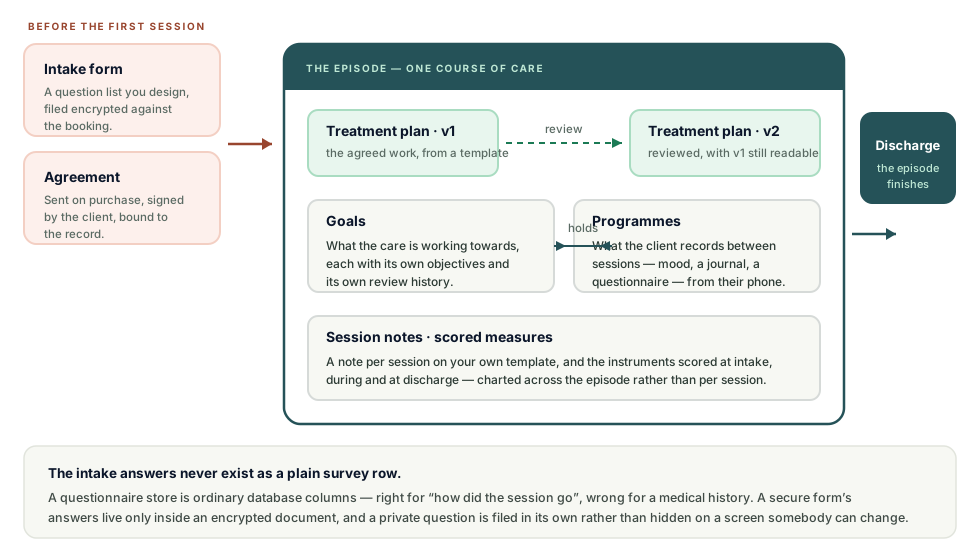
Intake, episode, plan, goals — and a signed agreement holding it together
A diary with a notes box is not a clinical record. These four are the structure a supervisor, a payer or a regulator expects to find, and they are the reason the Practice plan exists at all.
Intake forms
The questions you ask before you meet somebody, asked once and kept properly.
- Written in the same question builder as everything else — one place to add a question type, not four
- Named on the service, so the right form goes out with the right kind of appointment
- The client fills it from the booking link, on a phone, before the first session
- No plain answer row is ever created. The answers exist only inside an encrypted document, as a readable version and a machine one
- A private question is filed in its own document rather than hidden on a screen somebody can change
- Listed on the episode, so a year later you can see what they said at the start
Episodes of care
A named course of care with a start and, later, a finish — not an endless list of appointments.
- Opens at first contact and closes at discharge, with the reason recorded
- Everything hangs off it: the plan, the goals, the notes, the measures, the intake forms
- A client can have more than one over the years, each complete in itself
- A returning client keeps their history instead of starting again
- The client sees their own episode as My plan, with the goals you have shared
- Outcomes read across the episode, which is the only level at which they mean anything
Treatment plans and goals
The agreed work, in versions, so a review is a new version rather than an overwrite.
- Start from a template you have written, or from a blank plan
- Goals, each with its own objectives and its own review history
- Mark a goal reviewed or close it, with who decided and when
- A programme under a goal: what the client records between sessions, from their phone
- Version two never destroys version one — both stay readable, which is the point of a review
- Share a goal with the client or keep it to yourself; sharing is a decision, not a default
Agreements and e-signature
Consent and engagement letters signed where the record can hold the signed copy.
- Pin a template to yourself, or a different one to a particular service
- Sent automatically when the client buys, before the first session
- The client signs from an email or from My agreements in their portal
- The signed PDF is bound to the record it belongs to, not filed in a folder beside it
- Waiting and signed counts on your dashboard, so nobody is seen without one by accident
- Produce it years later, with its certificate, because retention is set per document type
Diary holds no clinical record at all — no note, no plan, no measure, no intake form, no clinical document. That is why it carries no percentage. If you keep your records somewhere else, you should not be paying us to hold them, and we should not be holding them.
Plans
Three plans. Two weeks free on all of them.
Per practitioner, billed monthly or yearly, cancel whenever. Prices exclude VAT. The share we take of client payments is further down the page, in a table, because that is the part most software leaves out. For every difference between the three, row by row, see the full comparison.
Diary
plan 1
For a therapist who keeps their own records and just wants the booking and the money to run themselves.
£228 a year if you pay monthly£15.83 a month, billed once a year
Start two weeks free- Your own booking page and real availability
- Client list, contact details and consent record
- Invoices, payment links, packages and credits
- Email and SMS reminders
- Cancellation and late-change policy, applied automatically
- No clinical notes, plans or measures
- No clinical documents held by us
Practice
plan 2
For a therapist who wants the clinical record in the same place as the diary, kept properly.
£540 a year if you pay monthly£37.50 a month, billed once a year
Start two weeks free- Everything in Diary
- Encrypted clinical notes and your own templates
- Episodes of care, treatment plans, goals and objectives
- Scored questionnaires and between-session monitoring
- Documents, consent and e-signature
- Client portal, secure messaging and shared plans
- Access log on every record
Clinic
plan 3
For a practice with more than one practitioner, rooms to manage and somebody who has to answer for all of it.
Up to 5 practitioners, then £15 eachUp to 5 practitioners, then £150 each a year
Start two weeks free- Everything in Practice
- Several practitioners, rooms and group sessions
- Roles and access control, with an audit trail
- Supervision and caseload review
- Clinic reports: utilisation, no-shows, outcomes, money
- Payouts and statements for your practitioners
- Priority support and onboarding help
The marketplace
Be found — and keep your own clients yours.
Every plan includes a listing. Clients who find you through us are charged at the platform rate; clients you bring yourself never are. Both are on the same page so you can see which is which before you join.
| Our share | When it applies |
|---|---|
| 0%plus the plan | Diary plan, your own clients. We hold no clinical data and take no share. |
| 3%plus the card fee | Practice or Clinic, your own clients, money through us. Collect the money yourself and it does not apply. |
| 20%of that client | A client we introduced. They found you in the directory and we sent them to you. Clients you brought are never charged at this rate. |
| 30%no subscription | Marketplace only. No plan, no monthly fee, no practice software — a profile, a booking page and payment. |
- Which clients we introduced is recorded at first contact and shown on your dashboard, so the 20% is never a surprise at the end of the month.
- Your own short link — print it, post it, put it in your email signature. Anybody who arrives through it is yours, at your own-client rate.
- A client the marketplace introduced stays at the platform rate afterwards. We say so here rather than in clause 14.
How we promote you
What the platform does, and what we will not claim
Read this section carefully, because the platform’s part and our part are different things.
What the platform does, mechanically
All of this is built and running
- Listing and search — your profile in the directory, on category and service pages, and in the apps
- A public profile that ranks — biography, specialisations, languages, qualifications, video; indexable content about you
- Your answered questions — public Q&A is findable content carrying your name, and it accumulates
- Reviews — moderated by you before publication
- The site and content engine — our blog, campaigns and newsletters run on the same system your profile lives in, so an enquiry and a booking are the same record
- Events and courses — registration, reminders, attendance, certificates
- Your own analytics — views, enquiries, conversion
What we will not promise
Placement, not volume
We can commit to listing you, to the inputs that decide ranking, and to including you in campaigns — and keep that promise every month.
We will not promise you a number of clients. That depends on demand we do not control, and a therapist who was promised clients and got none does not renew. Anything we do commit to commercially belongs in your contract, in writing, not on a web page.
- Which channels we promote on, and how often — in your contract
- Whether promotion is included in your plan or is paid — in your contract
- How a featured listing is earned, if at all — in your contract
Work out your own number
We will not hand you a return figure, because we would be inventing it
Here is the arithmetic instead. Every input is a number you already have or can get in an evening.
| Line | What to measure |
|---|---|
| A | Hours a month on admin, write-up and chasing × what an hour of your time is worth |
| B | Late cancellations and no-shows a month × your session fee, less what you currently recover |
| C | Sessions paid for but never booked, last twelve months × your fee |
| D | Clients who enquired and never converted, where nobody followed up |
| E | What you pay now for booking, notes, invoicing and a website, added together |
A + B + C + D + E against your plan fee and commission. If it does not clear, say so — and tell us which line was weakest, because that is more useful to us than a signature.
Before you can be listed
Five things, and one honest note about verification
- Professional registration — checked against your country’s register where one exists
- Qualifications — recorded on your profile
- A signed agreement, where your plan requires one
- A complete profile — photo, biography, at least one service with a price and a duration
- Availability — you cannot be listed with an empty calendar
On verification, plainly: what we can check depends on what your country publishes. Where a public register exists we check it and re-check it. Where none exists, your listing says what was and was not verified rather than implying a licence that does not exist.
Your first two weeks
Every feature of the plan you picked, no card, nothing to cancel.
- 01Sign up and pick a plan to try
- 02Add your services, your prices and your hours
- 03Import or invite your existing clients — they stay yours
- 04Complete your profile and go live in the directory
At the end you choose a plan or you do not. If you do not, the account stops taking new bookings and your records stay readable rather than being locked or deleted.
Two weeks, no card, your own data
Start on any plan. Move, change or leave whenever you like — and take a readable export with you on the day you ask.